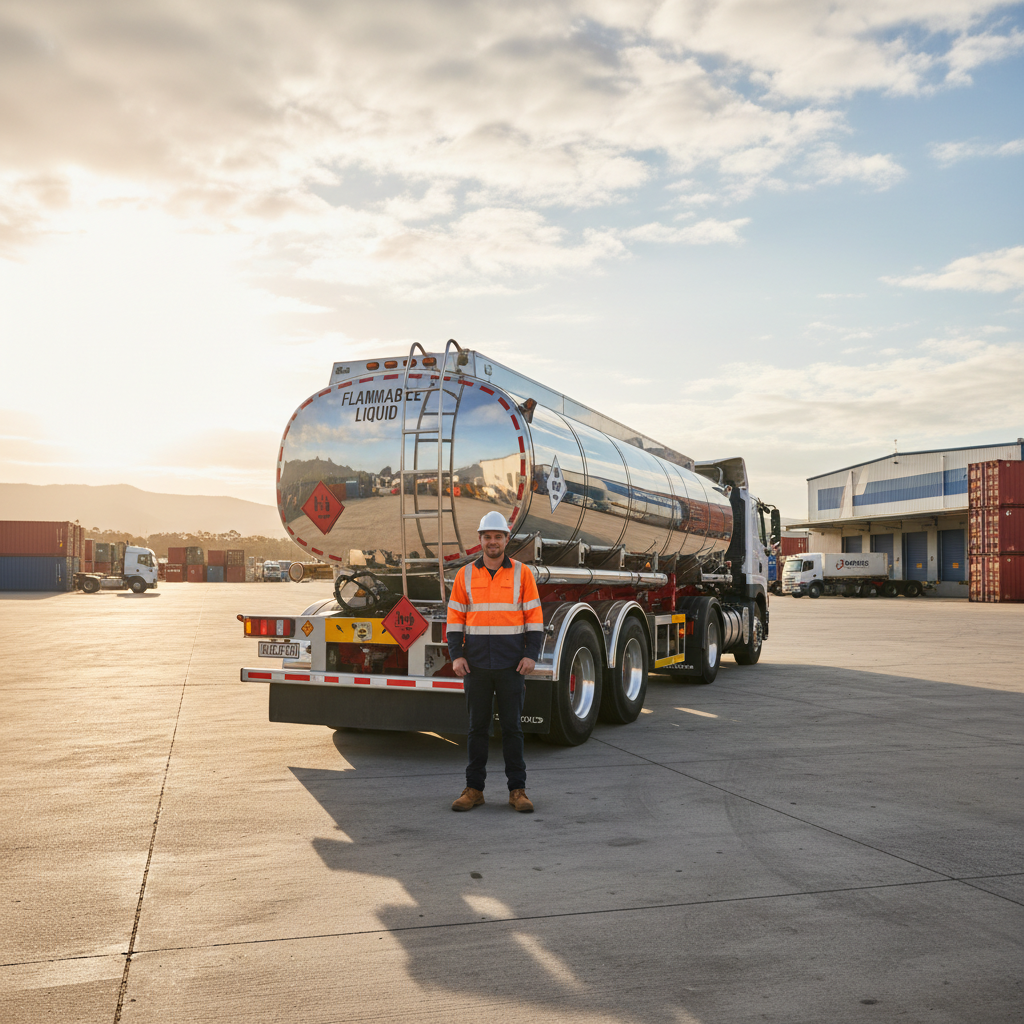
If you transport goods by road in NSW, you need to know whether your load requires a Dangerous Goods Driver Licence. Get it wrong and you’re not just risking a fine — you’re operating illegally under NSW law and the Australian Dangerous Goods Code.
This guide cuts through the regulation and tells you exactly which loads trigger the licence requirement, what placardable quantities mean in practice, and what to do if you need to get licensed.
What is a Dangerous Goods Driver Licence?
A dangerous goods driver licence is required if the vehicle
- is carrying any quantity of dangerous goods in a receptacle with a capacity of more than 500 litres; or
- is carrying any receptacle containing more than 500 kilograms of dangerous goods.
Note: a receptacle is a container that holds the dangerous goods substance or article and is in contact with the substance or article.
The licence is tied to the unit of competency TLILIC0001 — Licence to transport dangerous goods by road.
Without this licence, you cannot legally drive a vehicle carrying ‘bulk’ dangerous goods. The NSW Environment Protection Authority (EPA) administers the licensing scheme, and Kells Safety Centre — as a registered RTO (RTO ID 91528) — delivers the accredited training and manages your EPA application from start to finish.
What Are Placardable Quantities?
A placardable quantity is the threshold amount of a dangerous good that, once reached or exceeded, triggers legal obligations under the Australian Dangerous Goods Code (ADG Code) — including the requirement to display placards on your vehicle and hold a valid DG licence.
How Placardable Quantities Are Calculated
Placardable quantities vary depending on the class and packing group of the dangerous good. For most liquids and solids, the threshold is calculated by aggregate quantity across all packages in the load. For example:
- Class 3 Flammable Liquids (e.g. petrol, diesel, ethanol): Placardable at 1,000 litres or more in total
- Class 2 Gases (e.g. LPG, compressed oxygen): Placardable at specific cylinder quantities — varies by sub-class
- Class 6.1 Toxic Substances: Thresholds are lower — some trigger at just 500kg
- Class 8 Corrosives (e.g. battery acid, caustic soda): Placardable at 1,000 litres / 1,000kg depending on form
Why the Threshold Matters
Below the placardable threshold, different but still significant obligations apply — correct packaging, labelling and documentation are still required. But once you hit or exceed the placard load threshold, you must display placards on the vehicle AND the driver must hold a current Dangerous Goods Licence. No exceptions.
Ready to get compliant? Enrol in the Dangerous Goods Licence Course NSW with Kells Safety Centre — RTO 91528.
Which Classes of Dangerous Goods Require a Licence?
Ready to get compliant? Enrol in the Dangerous Goods Licence Course NSW with Kells Safety Centre — RTO 91528.
The ADG Code divides dangerous goods into nine hazard classes. The DG driver licence requirement applies to transport of placardable quantities across most of these classes. Here’s what you need to know for each:
Class 2 — Gases
Includes LPG, compressed natural gas, oxygen, acetylene and chlorine. Sub-classes cover flammable gases (2.1), non-flammable non-toxic gases (2.2) and toxic gases (2.3). Tanker drivers carrying bulk LPG and drivers transporting gas cylinder loads at placard quantities require a DG licence.
Class 3 — Flammable Liquids
This is the most common class encountered in NSW transport. Petrol, diesel, aviation fuel, ethanol, solvents and paint thinners fall here. Fuel tanker drivers and bulk liquid transport operators almost always hit the placard threshold and must be licensed.
Class 4 — Flammable Solids
Covers flammable solids (4.1), spontaneously combustible substances (4.2) and substances that emit flammable gas on contact with water (4.3). Less common in everyday freight but critical in mining and agricultural supply chains.
Class 5 — Oxidising Substances and Organic Peroxides
Includes fertilisers (ammonium nitrate), bleaches, hydrogen peroxide and organic peroxides used in manufacturing. High consequence if involved in a crash — licence required at placard quantities.
Class 6 — Toxic and Infectious Substances
Class 6.1 covers poisons and toxic chemicals (pesticides, herbicides, industrial chemicals). Class 6.2 covers infectious biological substances. Drivers transporting bulk pesticides or agricultural chemicals often require a DG licence.
Class 8 — Corrosive Substances
Battery acid, caustic soda, hydrochloric acid, sodium hypochlorite. Common in industrial, cleaning and manufacturing supply chains. Drivers transporting bulk corrosives in NSW require licensing at placard loads.
Class 9 — Miscellaneous Dangerous Goods
Includes lithium batteries (a growing compliance area), dry ice, environmentally hazardous substances and elevated temperature substances. As e-commerce and EV supply chains grow, Class 9 compliance is increasingly relevant for NSW transport operators.
Need to get your Dangerous Goods Licence?
Kells Safety Centre delivers the nationally accredited TLILIC0001 course across Wetherill Park and Wollongong. The $618 course fee includes your NSW EPA licence application — we handle all the paperwork.
View the DG Licence Course →Common Loads That Require a DG Licence in NSW
To make this practical, here are the most common load types NSW drivers and operators encounter that trigger the DG licence requirement:
- Fuel tankers — petrol, diesel, aviation fuel (Class 3)
- LPG deliveries — bulk tankers and cylinder deliveries at placard quantities (Class 2.1)
- Agricultural chemical deliveries — bulk pesticide and herbicide transport (Class 6.1)
- Industrial chemical tankers — caustic soda, acids, solvents (Class 8 / Class 3)
- Bulk fertiliser transport — particularly ammonium nitrate-based products (Class 5.1)
- Paint and coating deliveries — bulk flammable solvent-based products (Class 3)
- Gas cylinder deliveries — oxygen, acetylene, compressed gas at placard threshold (Class 2)
- Mining and explosives supply — precursor chemicals, Class 5.1 oxidisers
If your regular freight falls into any of these categories and you’re carrying at or above placardable quantities, a Dangerous Goods Driver Licence is not optional — it’s a legal requirement.
Are There Any Exemptions?
Yes — but they are narrow. The ADG Code provides limited exemptions for quantities below the placard threshold. Common scenarios where a DG licence is not required include:
- Carrying small quantities of dangerous goods below the placard threshold (e.g. a tradie carrying two 20L jerry cans of fuel)
- Consumer quantities transported for personal use (e.g. a gas bottle for your BBQ)
- Some agricultural vehicles operating under specific state exemptions
Importantly, even when below the placard threshold, obligations around packaging, labelling and documentation still apply under the ADG Code. If you’re unsure whether your load is exempt, the safest approach is to check directly with the NSW EPA or complete Dangerous Goods Awareness training to understand your obligations.
What Happens If You Drive Without a DG Licence?
Operating a vehicle carrying a placard load without a valid DG licence is an offence under NSW law. Consequences include:
- Significant financial penalties for the driver and potentially the employer
- Vehicle defect notices and immediate prohibition from continuing the journey
- Employer liability — transport companies who allow unlicensed drivers to carry DG face their own penalties
- Insurance implications — an unlicensed driver involved in a DG incident may void commercial insurance coverage
NSW Police and the NHVR conduct roadside compliance checks. DG licence verification is a standard part of heavy vehicle inspections.

How to Get Your Dangerous Goods Licence in NSW
Getting licensed is straightforward. Here’s how it works at Kells Safety Centre:
- Enrol in the TLILIC0001 course — 2 days face-to-face training at Wetherill Park or Wollongong
- Complete training — 7:15am to 3:30pm each day. Covers ADG Code, placard requirements, emergency procedures, documentation and practical application
- We handle your EPA application — once you’ve completed training, Kells manages the full EPA licence application process. Document submission and the EPA processing fee are all included in your $618 course fee
- Receive your NSW EPA DG Licence — issued directly by the NSW EPA
There’s no separate paperwork chase. Everything from training to EPA processing is managed under one roof.
Ready to get your Dangerous Goods Licence?
Join NSW drivers and logistics operators who’ve completed their TLILIC0001 with Kells Safety Centre. Courses run at Wetherill Park and Wollongong. $618 all-inclusive — EPA processing included.
View All Training Courses →


Frequently Asked Questions
Do I need a DG licence to carry petrol or diesel in NSW?
If you’re carrying petrol or diesel at or above the placardable quantity threshold (generally 1,000 litres for Class 3 flammable liquids), yes — you need a valid NSW Dangerous Goods Driver Licence. Small quantities below the threshold for personal or agricultural use may be exempt, but you still need to comply with packaging and labelling requirements under the ADG Code.
What is a placardable quantity of dangerous goods?
A placardable quantity is the minimum amount of a dangerous good that, when transported, requires the vehicle to display ADG Code placards and the driver to hold a DG licence. The exact threshold varies by class and packing group — for most Class 3 liquids it’s 1,000 litres. The ADG Code tables define the threshold for each dangerous goods class.
Does the DG licence cover all classes of dangerous goods?
The TLILIC0001 unit covers the transport of dangerous goods by road under the ADG Code broadly. However, some specific substances — such as explosives (Class 1) and radioactive materials (Class 7) — have separate licencing and regulatory frameworks. Your course trainer will clarify the scope of the licence in context of your specific industry.
How long does the dangerous goods licence course take?
The Kells Safety Centre TLILIC0001 course runs for 2 days, 7:15am to 3:30pm each day. It’s delivered face-to-face at Wetherill Park (Western Sydney) and Wollongong / Dapto.
Does the EPA process my licence application?
Yes — the NSW EPA issues the Dangerous Goods Driver Licence. Kells Safety Centre handles the full application process on your behalf after training is complete. The $618 course fee includes EPA processing fees, document submission and EPA application management.
Can I drive interstate with a NSW dangerous goods licence?
The TLILIC0001 is a nationally recognised unit of competency and the ADG Code applies across Australia. However, licensing administration varies by state. Your NSW EPA licence is NSW-administered — if you’re regularly operating interstate, it’s worth confirming requirements with the relevant state authority or the NHVR.
What’s the difference between a DG licence and dangerous goods awareness training?
A DG licence (TLILIC0001) is a legal requirement for drivers transporting placardable loads by road. Dangerous Goods Awareness training is designed for workers who handle or work near dangerous goods but aren’t driving them — warehouse staff, depot workers, admin and safety personnel. Awareness training does not replace or substitute for the DG licence.
Kells Safety Centre delivers accredited transport safety training across NSW — Wetherill Park and Wollongong. View All Courses